Gen X Rises

Hello forgotten generation!  Or, if you’re not a Gen X’er congratulations for being one of very few who are remotely interested in learning about us; the middle generation and baby bust generation. Then there’s the descriptors; slackers, apathetic, lazy, sulky…you’ve heard it.  Well, as a middle child, I’m fed up with it being used to describe some pathetic, whiny child.  Think Jan Brady ‘s voice, “Marsha, Marsha, Marsh!” Yes we’ve all felt that way at one time or another, but now that I’m mid-life my reaction to these comments is, “Whatever.”

I’m not alone in realizing we aren’t going to change the opinions of others. Harkening back to our teen years we know this isn’t a new thing.  A lot of us did a good job of shaking it on and getting to work on our lives in spite of the low expectations.  We showed them!

Many of us, parents or not, feel the pull of Boomer commentary: This generation is so sensitive and doesn’t have the backbone we had. We were hard-working…look how lazy they are!” If you’re like me, you also immediately cringe at the thought of becoming like it, no matter how accurate the commentary.

We’ve made it this far by using our strengths, our Superpowers, to succeed in life.  We’re hard-working, self-reliant, adaptable, and use our gallows humor to cope with all the crap life throws at us. We’ve applied it to all areas of our lives. We worked hard knowing not to expect praise for doing so. We didn’t expect others to swoop in and save us; we had to save ourselves and those we care for. Change is constant and has been since we came on the scene so we’re baffled at everyone railing against how everything is different than when they were young.  Duh. Finally, we’ve been through a lot.  Recession, cold war, AIDS, dot com bust, another great recession and let’s not forget Covid. Our Generation’s response has been to joke our way through because what was the alternative?   We put our heads down and kept working. This has helped us succeed and yet we’re seeing diminishing returns.

The world seems to reward our grit less every year. Laughing off serious issues brands us as, at best, insensitive. Working hard seems to result in more work being put on our plates through this never-ending pipeline because we always seem to figure it out and make it work. The solution is not to abandon all these skills but to apply them in a new way.  We’ve changed, the world’s changed and it’s time we adapt to it. Like all generations, when we hit mid-life most of us start to reflect, reassess, and start searching for what’s next.  I hate the Boomer term Mid-life Crisis because it’s so dramatic and black and white.  Sure, some of us do have a crisis, but most just have a change in thinking and priorities.

Stay tuned for more in my upcoming book……
Gen X Women are Tired

I’ve never liked stereotypes, especially about women. I have never felt like the ‘typical’ woman, feminist, stay at home mom or working mom’. They’re just too confining. The more I talk to other women around my age, I realize many feel the same.

I’m Gen X and while I hate stereotypes I embrace a lot of our labels. We’re resilient, independent and generally tend to suck it up and get on with life when we encounter problems. We also have little respect for the establishment; those who say ‘trust us.’ 

In some ways our generation has been trained to handle the ups and downs of life. We grew up during the 70’s and 80s with some old enough to see the effects of the oil crisis and high inflation. All of us witnessed the boom in the 80s with it’s mantra of “greed is good” . We were young adults through the 90s with new definitions of sex, the dawn of the internet boom and bust and the fall of the Soviet Union. Most of us were full adults in our 30s and 40s when the Great Recession hit and experienced Covid in our middle age.

This isn’t to whine; we know that doesn’t do any good. Boomers complain about the failure of society and the undoing of everything they’ve done. Millennials complain how unfair it all was and they deserve more. Most of us are like, “Whatever.”

But we’re tired. Speaking as a woman I know we’re particularly and uniquely tired. We have opportunities our moms fought for and we’ve tried to take advantage of them. I was raised with two brothers and told I can do anything they can do. Yet my female examples were traditional and I admired their strength. My favorite song at 5 was “I am Woman Hear me Roar” which I would belt out at any opportunity with my mother looking on proudly. We could do everything. 

I entered the workforce confident and focus on personal achievement; ready to out guy the guys. However, when I emulated their attitude my reception was very different. I remember my first formal review was glowing except the one area for improvement was, “you need to not contribute so much so others have the opportunity.” I was raised in a family where you were expected to speak up and was baffled by the comment. Now I wonder if any of my male peers got that constructive criticism. 

I also began to realize if I want a husband, my odds were better younger. If I want to have children, my biological clock dictated I had to do it in my 20s or 30s. If I want to be admired in general society, shouldn’t be too dominating or pushy. I had to put others ahead of myself and make people feel comfortable. Kick ass and achieve, but do it with a self deprecating smile on your face. A different set of hidden rules existed for us.

It’s time to break this false dilemma. We do not have to be one or the other AND we don’t have to strive to be both.

We can be what we want to be.

Negotiating Life

I’m a born negotiator. Early on I deftly wove between friend groups, mediated for my brothers to prevent bloodshed and instinctively knew the best thing to do to keep everyone happy.  Our dinner table was our arena in which to hone our skills and everything was fair game.  It was exhilarating, terrifying; we learned how to make strong arguments and hold our own. As any good litigator knows it’s not just bullying people, although there’s some of that, it’s delving into what they feel, how they think and tailoring your arguments to be the most convincing to them. Of course primarily, my family is about winning.  There were no participation trophies. In the end you worth was based on the scoreboard.

For the last 24 years my job has depended on negotiating skills, persistence and being tough skinned.  I’ve thrived through thousands of deals and love the challenge. Yes, I get massive dopamine hits from making a deal happen that took two years, hit numerous road blocks and had tenous moments. I persisted, fought and won. I’m admittedly addicted to the chase, but I also revel in the process. My negotiating was all about the first definition of that word:

1. A.To deal with some matter or affair that requires ability for its successful handling.  B. to arrange for or bring about through conference, discussion, and compromise.

Having kids has been like getting a Phd in negotiations. Nothing is tougher than maintaining calm during a high stakes stand off with an autistic toddler. Or watching your teenage daughter descend into depression, self loathing and anxiety; trying all your tricks and skill yet failing to negotiate a solution. Feeling the pain of my old soul youngest at 12 lamenting her lack of connection to peers because she wants to talk about deep things. Not tic tok, boys and the latest pop songs.  She can do that, but the masking is physically and mentally exhausting.  She’d come home from school and go to bed. For the night. Feeling hollow I tried to make her feel seen, appreciated enough to not hurt; and failed.  Trying to give her hope I told her with age comes more opportunities as those peers catch up. Her wise response being “So I’m suppose to just wait for my life to start?” This led me to embrace the third definition of negotiating:

3. a. to successfully travel along or over

I believe this should be the primary definition because the other is just a skill, a tool used in service of this. Sometimes there is no deal; it can’t be made or solved.  Not really.  I encounter it often in my career and although it,s disheartening, I now accept sometimes there is no deal to be made.  The two sides have different needs, are too far apart or the deal someone wants just doesn’t exist. Accepting that reality is hard; even harder in life.

When my daughter was in 2nd grade in a small private school she hit a wall. She’s so smart, sweet, wants social interaction and she’s autistic.  For her it manifested in frustration and uncontrollable emotions at not being able to put it things into words.  Sometimes it was sensory that overwhelmed, intense and uncontrollable. Sometimes it was feelings; feeling misunderstood, feeling the tension, anger, disappointment in the room.  Not aware it was seeping into her without a filter; exploding out of her like a dam bursting. Second graders don’t act this way, they control their emotions in appropriate ways.  She couldn’t and that’s not acceptable.

Realizing there wasn’t a deal to be made for my girls was hard. Accepting they were different, would never be typical and will always treated as such by society.  I’d lost that negotiation.  And yet, I was embracing the only real way to successfully negotiate the world.  Meeting it, and them, where they are, not where I want it to be, and from there moving forward.

My young self would say that’s complacency, giving up, failure. It often feels that way but to know where you want to go, how you might get there, requires knowing where you’re starting. Not much dopamine in it, but plenty of serotonin.

Can you absolutely know that’s true?

After typing thoughts randomly to commit to getting this started I’m going to attempt to stick to some themes and change my topics. Being a self-identified, undiagnosed person with ADHD, embracing the topic of Neurodiversity allows me just enough options to not feel too constrained. We’ll see how that goes.

The impetus for this pivot is my journey into understanding myself and my daughters to help all of us live content lives. Quite an undertaking that’s never going to reach a finish line and no map exists to follow. This realization was my first step.

We’ve all heard the saying, “the first step is admitting we have a problem.” Here I’m addressing the ‘problem’ of thinking we can directly cause other people to change. Yes, you’re probably yelling “But you can!” I get it that’s been me and I still fall into that thinking constantly. To not think so means you’re giving up, being complacent and lazy, right?

It can, but doesn’t have to be. I’ve found the more I accept what is, and how limited my ability is to influence others, the more I’m successful in doing just that. Trust me, that’s not an easy thing to do.

When dealing with people, and neurodiverse people in particular, in order to accept what is you have to actually find out what is. This is way more difficult than it first appears because we all see what is through our perception and interpretation. Byron Katie has a helpful way to question if your thoughts are reality and my favorite is “Can you absolutely know that’s true?” Of course especially when dealing with other people’s motives, feeling, expectations etc. we can NEVER answer yes because we aren’t mind readers. We figure out what we THINK is going on by past experiences, how we feel when we act a certain way, societal norms; you name it. Just accepting this one thing threw me back on my heals and into chaos and doubt. Fun right?

No, but necessary. I don’t always like what I see but I actually see it more often than I did. The challenge for me is to focus, ask, listen and accept what that person says IS no matter what my judgement is about it. No I don’t stop judging, doubting, thinking they’re wrong, feeling agitated. However, I am better at not acting on those uncomfortable feelings.

I think the song “The Long and Winding Road” and that is the tip of the iceberg

Are you an employee or an owner?

Well, kind of both. I’m continually reminded when I speak with others that my position in commercial real estate as a broker and independent contractor is not normal. Well, it’s normal for my industry but not in the broader professional world.

It’s an interesting situation where you are part of a company, but legally you’re really not. The company has no obligation (other than what you contract with them) to provide a work environment, healthcare, paid time off or anything else that’s considered normal in the job market. On the contractor side the benefit is freedom and unlimited upside in pay; you can set your own hours, work or not work when you want and generally not be compelled to do much of anything that annoys many professionals these days (i.e. out of control zoom meetings).

I’ve been in this business for a couple decades so obviously I find it appealing, however it does set up a peculiar dynamic where you have your sales people and then you have your “real” employees. Even when everyone has good intentions it creates a rift where employees can resent how sales people don’t have to “play by the same rules” and the sales people can feel like their only valued for the money they bring in, not as a person on the team.

We consider ourselves advisors and professionals along the lines of an attorney, accountant or financial planner. For those occupying or owning any physical location, this investment is one of the most important bottom line numbers and culture creating tools. And yet, our pay is usually based on a transaction that may or may not happen while the accomplished among us serve our clients not the transaction. Our most precious resource is our knowledge, experience and advice, so why aren’t we paid for that instead of, or in addition to, the deal?

Short answer: That’s how it’s always been done. Long answer: Sellers and Landlords pay the fee and occupiers don’t want to have to pay it.

Never liked those answers.

When choosing integrity sucks

Everyone talks about integrity and how great it is to stick to your principles.

Not many talk about how much it sucks.

If your integrity and principles are really tested it’s going to be hard. Not, “I found a wallet and should I return it” hard, more like, “if I stick to my principles someone I love may not want me in their lives anymore”.

That’s big league pain that isn’t going away anytime soon.

Finding your Why

I read Simon Sinek’s books Start with Why and Find your Why a couple years ago and recently revisited them. The idea is everyone has a core “why” and they thrive in life and business when their work aligns with it. Pretty simple concept but not so easy to pin down.

I’m in sales but always felt that was not a good descriptor of what I do. While the end goal is often to help a client buy/sell commercial real estate, the bulk of my work is first figuring out what they need and then finding a solution. I love getting to connect with a variety of people to accomplish this. Input from the company, knowledge gained from past clients and the constant interaction I have with colleagues in the market are all crucial.

Ever since I can remember, connecting with people has been important to me. One of the most painful things I’ve experienced is failure to really connect with some of the people I love deeply. For me, connecting is deeper than just exchanging updates or being together. It’s being able to interact in a way that increases each other’s knowledge about who the other person really is. What’s important to them, what makes them tick. It’s a beautiful thing when both people are interested and gain insight in each other. Really SEE each other; even if you don’t have the same interests or beliefs. Another great part is you can catch glimpses of this in short conversations with strangers. A genuine, “how’s your day going” at checkout that engenders a real response of “hanging in there and almost done with my shift,” is satisfying to me.

While a work in progress I finally have a draft of my why:

To form honest connections with people so that life is enriched

Hero’s Journey

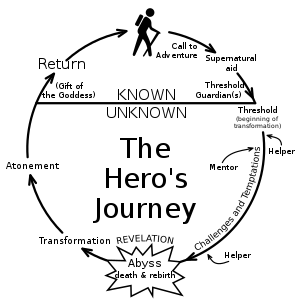
While watching “Cloak and Dagger” last night I was reminded of the Hero’s Journey when one of the scenes referred to it. The term was coined in a biography describing Joseph Campbell’s works and in particular his book, Hero with a Thousand Faces. The story arc evident in writings back to ancient Greece, and probably beyond, is a great reminder for facing difficulties.

As in almost every religion, in order to grow in any significant way we must experience hardships. This always struck me as a bit sadistic but in facing my own challenges, and my own personal abyss, this idea is comforting. Of course you always have the choice of staying in the abyss, of not transforming and not pushing through to the other side but at least there always IS the other side. Placing this responsibility of climbing out squarely in the hero’s hands is liberating and terrifying. While we can blame many people and things for getting us there only we can get us out.

Remembering 2020

Don’t worry, this is not a pollyanna post about the silver linings of 2020, though they do exist.

2020 tested this eternal optimist not just because of the challenges, but because there often seemed nothing to DO to fix it. Problem solving is what I do, what I thrive on in work and in life. There’s always a bump in the road, unforeseen challenge with a deal or with kids and usually my response is get creative, work harder, find the answer.

Except sometimes the answer is to wait. Be patient. Accept all the parts of the world you can’t control and let them go. Then look for what you can do.

I heard/read recently that the most difficult part for people about the pandemic is the lack of control we have; and yet the reality is we NEVER had control. Not really. Not over life and death, the unexpected or others in our life.

As we hit 2021 with renewed energy and hope I will try and remind myself of what 2020 plastered right in front of my face and wouldn’t move: focus on what we CAN do, not what we can’t.

Learning to love the process

I’ve always been focused on goals, achievements, the end game. Over the past few years I’ve realized this is truly an infinite game (also great book by Simon Sinek) and we better find enjoyment in the playing of it; not the winning. Easy to do when talking about enjoying the good time and happy moments with kids, spouse, family and friends. Hard to do when things are going wrong, you’re not achieving what you want, kids are struggling and times are difficult. I believe it was on Tim Ferris’s podcast I first heard the term “Embrace the Suck”. For a type A competitive person that’s about the hardest thing to do. Fix, achieve, correct, improve, rage, push harder, search for a solution, do more. That’s how to succeed. Accepting there are things you can’t fix is complacency, weakness, failure. Right?